
Flow State: Understand what it is and why it is important

|
Getting your Trinity Audio player ready...
|
THE flow state It is a fascinating concept that has captured the attention of psychologists, researchers and personal development enthusiasts.
Imagine a moment when you are completely immersed in an activity, losing track of time and feeling totally involved in what you are doing. This is the flow state, a state of total absorption that brings with it a series of benefits.
In this article, we will explore what is flow state, why it is important and how we can cultivate it in our lives.
What is the flow state?
THE flow state is a term coined by the psychologist Mihaly Csikszentmihalyi to describe a mental state in which a person is completely immersed in an activity, feeling energized and focused. During the flow state, the person experiences a deep sense of involvement and concentration, losing track of themselves and the world around them.
“"The flow state is a mental state of total focus and deep involvement in an activity, in which the person loses track of time, reduces self-consciousness, and experiences high performance with intrinsic satisfaction."”
How did the “discovery” of the flow state come about?
Mihaly Csikszentmihalyi, a renowned Hungarian-American psychologist, did not exactly “discover” the flow state, but he was the one who coined the term and conducted extensive research on this mental state. His exploration of the concept began in the 1970s.
Csikszentmihalyi was interested in understanding what made people become deeply involved in their activities and experiences, often losing track of time and feeling completely immersed in the moment. He therefore conducted a series of studies and interviews with people from different cultures and backgrounds to better understand this experience.
Throughout your research, Csikszentmihalyi noticed that people described a similar mental state characterized by a sense of intense focus, deep engagement, loss of self-consciousness, and a sense of intrinsic satisfaction. Thus, he coined the term “flow” to describe this unique experience, which seemed to transcend cultural and contextual barriers.
The research of Csikszentmihalyi about the flow state resulted in his influential book “Flow: The Psychology of Optimal Experience”, where he delved deeper into the concepts and implications of this mental state. He also founded the Positive Psychology Research Center in the Claremont Graduate University, where he continued to explore issues related to well-being, creativity and positive mental states.
Flow state and Neuroscience
From a neuroscience perspective, the flow state is not merely a subjective sensation of focus or pleasure. It corresponds to a specific pattern of brain functioning, in which different systems begin to operate in an integrated and efficient manner.
During flow, there is a reduction in call activity. standard mode network — an area associated with self-criticism, rumination, and excessive thinking about the "self." With this, the mind stops expending energy on internal judgments and focuses almost entirely on the task at hand.
At the same time, there is a balance in the release of neurotransmitters such as dopamine and norepinephrine, responsible for motivation, attention, and the sensation of reward. Unlike motivation based on pressure or fear, in flow the brain enters a state of... natural engagement, in which performance increases without generating emotional exhaustion.
This process explains why the flow state is associated with accelerated learning, heightened creativity, and a sense of mental clarity. The brain literally works with less noise and more precision.
Features and components
To better understand the flow state, it is important to highlight their distinct characteristics. Thus, they include a clear sense of goals and feedback Immediate success involves a balance between challenge and skill, intense concentration, reduced internal dialogue, and a sense of control over the activity. Then, when these elements merge, the person enters a kind of trance. Immersed in this experience, time seems to fly by and performance reaches extraordinary levels.
In summary, its main features are:
Intense and total focus on the activity.
THE flow state It is marked by an extreme level of concentration, in which the person ignores everything around them and is completely absorbed in the task.
Loss of perception of time
In flow, it is common to lose track of time. In this way, hours can seem like minutes, because the person is so involved that time passes unnoticed.
Balance between challenge and skill.
THE flow state Flow occurs when there is an ideal balance between the level of challenge of the activity and the person's abilities. Therefore, if the challenge is too high, the person may become anxious; if it is too low, they may feel bored. Flow is the point at which these elements are balanced.
Clarity of objectives and immediate feedback.
The person has a clear understanding of the objectives of the activity and receives immediate feedback, either through the results they observe or through the progression of the task itself.
Feeling of control
During the flow state, there is a sense of control over actions and the environment. As a result, the person feels that they have control over what they are doing, without anxiety.
Detachment from the ego
In flow, the person leaves aside concerns about the opinions of others, as well as judgments or insecurities. Total focus on the activity results in a disconnection from self-awareness.
Intrinsic satisfaction
Being in flow brings a feeling of satisfaction and well-being. Therefore, the activity itself is rewarding, regardless of any external gain.
“"The state of flow occurs when there is a balance between challenge and skill, clear objectives, immediate feedback, intense concentration, and a feeling of control over the activity."”
The importance of the flow state
THE flow state is not only an enjoyable experience, but it also plays a crucial role in our well-being and growth. Therefore, when we are in the flow state, we are more productive, creative and efficient.
Furthermore, this mental condition is linked to an increase in personal satisfaction and sense of accomplishment. Likewise, it is associated with a reduction in stress and anxiety, promoting a positive state of mind.
“Being in a state of flow increases performance, creativity, learning, and emotional well-being, while reducing stress, anxiety, and mental rumination.”
State of flow, mindfulness and presence
Although often associated with performance, the state of flow does not arise from excessive effort. It arises from presence. And it is here that flow connects directly with... mindfulness.
Mindfulness Mindfulness trains the ability to remain in the present moment, observing thoughts and sensations without getting lost in them. Flow emerges when this presence is combined with a challenging and meaningful activity. In other words, mindfulness prepares the ground; flow is the result.
While forced effort tends to trigger anxiety and self-criticism, mindfulness reduces interference from internal dialogue and allows action to flow more smoothly. Therefore, people who cultivate mindfulness enter a state of flow more easily and frequently.
Flow is not about "forcing focus." It's about stopping the struggle with the mind and allowing it to organize itself around the experience.
What blocks the flow state?
Many people believe they can't achieve a state of flow due to a lack of discipline or talent. In practice, the blockage is usually due to emotional and behavioral factors that are very common in modern life.
Excessive multitasking fragments attention and prevents deep immersion. Constant self-criticism keeps the mind in a state of vigilance, hindering spontaneous engagement. Anxiety about results shifts the focus from the process to the future, disrupting the experience of presence necessary for flow.
Furthermore, frequent digital distractions, fear of making mistakes, and environments with excessive stimuli raise the brain's baseline stress level, making flow increasingly rare.
Entering a state of flow requires less control and more Reduction of internal and external interference..

Flow state in real life: work, studies, and routine.
The state of flow is not restricted to artists, athletes, or extraordinary moments. It can be experienced at work, while studying, and even in everyday tasks, as long as the right conditions are created.
In a professional setting, flow emerges when there is clarity of objectives, autonomy, and challenges that match a person's abilities. In studies, it appears when learning ceases to be mechanical and becomes meaningful. In daily life, it can emerge in simple activities such as writing, organizing, teaching, or creating, as long as there is genuine engagement.
The key point is to understand that flow doesn't depend on the activity itself, but on... quality of attention, level of challenge, and meaning attributed to the experience.
When these variables align, action flows, time disappears, and performance soars—with less effort and more satisfaction.
In short…
THE flow state Flow is a powerful dimension of the human experience, allowing us to achieve exceptional levels of performance and satisfaction. Understanding what flow is and adopting practices to cultivate it gives us the opportunity to improve our quality of life, achieve our goals more efficiently, and find a deep sense of fulfillment in our daily activities. Therefore, we invite you to explore flow and integrate it into your journey of self-development and success.
Recommended reading:

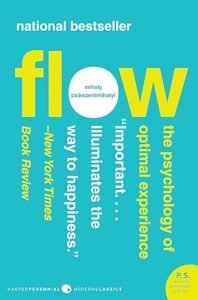
Flow: The Psychology of Optimal Experience (Harper Perennial Modern Classics) (English Edition) – Mihaly Csikszentmihalyi
Frequently asked questions about the flow state.
1. Is the state of flow the same as deep concentration?
Not exactly. Concentration is part of flow, but the flow state also involves intrinsic satisfaction, loss of self-consciousness, and a sense of control, creating a much deeper experience.
2. Can anyone enter a state of flow?
Yes. Flow is a universal human capacity. However, it becomes more frequent when a person learns to create the right conditions: clarity, appropriate challenge, and focus.
3. Is the state of flow linked to happiness?
Yes. Research shows that frequent experiences of flow are associated with greater well-being, sense of purpose, and personal satisfaction, even outside of leisure contexts.
4. Is Flow only for artists, athletes, or creatives?
No. The flow state can occur in any activity: work, study, sports, writing, programming, deep conversations, or even manual tasks — as long as there is genuine engagement.
5. Does the flow state help reduce anxiety and stress?
Yes. During flow, the mind shifts from constant worry to active presence, which reduces anxiety, rumination, and emotional tension.
6. Is it possible to train the brain to enter a state of flow more easily?
Yes. Practices such as mindfulness, clear goal setting, elimination of distractions, and emotional self-regulation significantly increase the frequency of the flow state.
7. Are flow and productivity the same thing?
No. Productivity can exist without flow. Flow, on the other hand, generates sustainable productivity, enjoyment in the process, and less mental strain.
8. Can the flow state become an addiction?
In rare cases, when a person uses flow solely as an emotional escape, it can lead to imbalance. Ideally, it should be consciously integrated into life, not used as escapism.
Image: Freepik
Article originally published on 08/07/2023 and updated on the date above.

Marcel Castilho is a specialist in mindset and human behavior. In addition to being an advertising professional, he also holds a Master's degree in NLP (Neuro-Linguistic Programming) and postgraduate degrees in neuromarketing, neuroscience, mindfulness, and positive psychology. He is a digital marketing expert and has been studying human behavior for over 30 years.