
Metacognition: what it is and how to use it to improve your mind and your results.
|
Getting your Trinity Audio player ready...
|
Most people spend the entire day thinking… without realizing they are thinking. Reacting automatically to stimuli, emotions, and mental habits that have been conditioned for years.
And this is precisely where metacognition comes in.
In this article, you will understand what metacognition is in a simple and practical way and, more importantly, how to use this skill to get out of autopilot, gain mental clarity, and start directing your thoughts, decisions, and results consciously.
Because, ultimately, you can't change what you don't notice.
And your mind only begins to change when you learn to observe it.
What is metacognition?
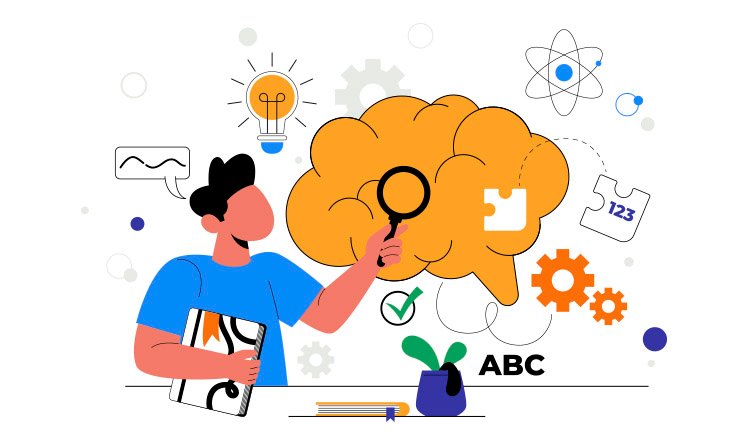
Metacognition is the ability to observe and reflect on one's own mental functioning. In other words, to perceive, analyze, and adjust how you think, learn, and process information.
In other words, you begin to identify which strategies work best for you, you can plan problem-solving more clearly, and you improve how you learn. The result is a smarter and more efficient learning process, a true mastery of "learning to learn." It is, essentially, the ability to perceive your own thinking as it happens.
That is, it's as if you step out of the role of a character and assume, for a few moments, the role of observer of your own mind.
It may seem subtle, but it's not.
In practice, this means that you stop being automatically driven by thoughts, emotions, and impulses, and begin to see what is happening inside you more clearly.
“"Metacognition is the ability to observe, understand, and direct your own thoughts in real time."”
And that's exactly why she changes everything.
Because if you don't realize what you're thinking, you can't change it. You just react. And you react based on patterns that often aren't even your own; they were learned, repeated, conditioned.
Metacognition: skill or practice?
It is a (potential) skill.
From a psychological point of view, it is a cognitive ability. Thus, just like memory or attention, all human beings possess the biological potential to monitor their own thoughts. However, some people have this natural "tool" sharper, managing to perceive errors or patterns of behavior more easily.
It is a practice (action)
However, although everyone has the ability, it only produces results when it is... deliberately exercised. In this sense, metacognition functions like a mental "muscle".
- If you don't question how you're learning, the skill remains "dormant".
- When you decide, for example, to stop and plan how you are going to study a difficult subject, you are transforming that ability into a practice.
The mind's autopilot: the real problem
Above all, most people live on autopilot. And the problem isn't being on autopilot itself. After all, the brain needs it to save energy. The problem is when this automatic mode dominates important decisions in your life.
Have you ever caught yourself opening your phone without realizing it? Or starting one task and, a few minutes later, being on a completely different one? Or even reacting emotionally in an exaggerated way and only realizing it later?
This happens due to a lack of awareness about one's own mental functioning.
Without the practice of metacognition, you don't perceive the thought arising. In other words, you simply follow its flow. And this flow, most of the time, is loaded with distractions, fears, insecurities, and repetitive patterns.
“"Without the practice of metacognition, you don't choose your thoughts, you are driven by them."”
And when that happens, your life becomes a sequence of reactions, not decisions.
How metacognition works
Contrary to what it may seem, metacognition is not something abstract or detached from reality. It happens in very simple moments of the day and, precisely for that reason, goes unnoticed.
Imagine you're working and, suddenly, you feel the urge to check a notification on your smartphone. Without metacognition, you simply pick up your phone and, before you know it, you've spent minutes (or hours) browsing social media.
On the other hand, with metacognition, you perceive the impulse before acting. And it is in this space that the possibility of choice arises.
Over time, this process becomes clearer. You begin to identify recurring patterns, such as thoughts of procrastination, Self-criticism or avoidance of tasks. In this way, you begin to realize when you are anxious, when you are distracted, when you are simply avoiding something uncomfortable.
And, more importantly, it begins to interfere. Not in a forced way, but consciously.
Metacognition doesn't eliminate negative thoughts or distractions. It allows you to avoid being overwhelmed by them.
Metacognition, focus, and behavior: the invisible connection
If there's one thing people are constantly searching for, it's... improve focus. However, few realize that focus doesn't depend solely on discipline or environment.
It depends, first and foremost, on awareness. After all, you can only regain focus when you realize you've lost it.
It seems simple, but this is one of the most common mistakes. Many people spend minutes—sometimes hours—distracted without even realizing it. When they do realize it, they've already wasted energy and time. And they get frustrated about it.
Metacognition acts precisely at this point. It functions as an "internal alert," signaling when your mind has strayed from the path.
“"You don't improve focus by trying to concentrate more—you improve focus by noticing when you get distracted."”
And this completely changes the way you work, study, and live.
Why can't you change?
This is perhaps one of the greatest paradoxes of human behavior.
You know what you need to do. You know you should focus, act, avoid distractions… but even so, you don't.
Why?
Because knowing is not enough.
Without metacognition, knowledge does not translate into action. It remains at the rational level, while behavior continues to be guided by automatic patterns.
These patterns are formed by beliefs, emotions, and past experiences. They operate silently, often outside of your conscious awareness. And, as long as you don't observe them, you continue to repeat them. They are true. mental blocks, which sabotage our goals and objectives.
This explains why so many people feel stuck. They try to change their behavior without changing their level of awareness.
Change without awareness cannot be sustained.
Metacognition, mindfulness and mental reprogramming
Now we arrive at a point that connects everything.
If metacognition is the ability to observe thought, how do we develop it?
One of the most consistent answers comes from mindfulness.
THE mindfulness It trains the mind to be present. That is, it teaches you to observe thoughts, emotions, and sensations without judgment. And, in doing so, it strengthens precisely the metacognitive ability.
You start to notice before you react.
At the same time, when this awareness is strengthened, the possibility of change arises — and this is where change tools, such as NLP, play an important role.
You observe the pattern, understand its internal logic, and then you can reinterpret or replace it.
“"Metacognition creates awareness. Mindfulness strengthens that awareness. And mental reprogramming transforms the pattern."”
This integration is what allows for real and sustainable change.
How to develop metacognition in everyday life.
Practice observation.
Developing metacognition doesn't require complex techniques, but it does require practice.
It starts with something simple: observation.
Throughout the day, take small mental breaks. Ask yourself what you're thinking at that moment. Not to judge, but to become aware.
Over time, you start to notice patterns. Recurring thoughts, frequent distractions, and automatic reactions. And this opens up space for something new: choice.
Name internal states
Another powerful practice is naming internal states. When you say “I’m anxious” or “I’m avoiding,” you create a distance between yourself and the experience. And that distance reduces the intensity and increases clarity.
Practice self-explanation.
Whenever you are learning something new or solving a problem, try to explain to yourself (out loud or mentally) what you are doing and why you chose that path. This forces the brain to monitor the reasoning process.
Monitoring techniques (Checkpoints)
Create deliberate pauses during an activity to assess your level of comprehension. For example, when reading a book, stop at the end of each chapter and try to summarize what you've read without looking at the pages. If you can't, your metacognition is telling you that you need to adjust your focus.
Practice dissociation.
THE dissociation It can be used to improve metacognition, creating a mental distance that allows you to observe your own thoughts with more clarity and less emotional influence. By "stepping away" from the experience and analyzing it as an observer, you can identify automatic patterns, question interpretations, and adjust how you think and react.
This process reduces autopilot mode and increases awareness of how your mind works, making your decisions more rational, strategic, and aligned with your goals.
It's not about controlling the mind by force, but about understanding it.
Practical exercises to train your mind.
Mindfulness in practice
If you want to get started now, there's a simple and extremely effective exercise.
Set aside two or three minutes. Sit comfortably and close your eyes. Focus your attention on your breathing, observing the air going in and out. In a few seconds, your mind will wander, and that's to be expected.
When you realize you've become distracted, simply return to your breathing.
No judgment. No frustration.
This process, repeated several times, trains metacognition precisely: noticing and then returning to the previous point.
Over time, you start doing this not only in meditation, But in life.
Monitoring Pause
This exercise helps to take the brain out of automatic mode.
Try doing this now, focusing on your... current state:
The Diagnostic Question: Close your eyes for 10 seconds and ask yourself: “"What is my level of mental clarity right now, from 1 to 10?"” (Think about whether you are focused, distracted, or tired).
The "Why": Identify what caused this number. Is it tiredness from the day? Is it interest in the subject? The noise around them?
The adjustment strategy: If your level was low (e.g., 4 or 5), what would you do now to raise it to an 8? (Drink water? Breathe deeply? Change your posture?).
What happened here:
- You didn't just "feel" something, you analyzed What you felt (Metacognition).
- Did you use the clarity (which we looked for before) to evaluate your process.
- You acted like a "programmer" of your own mind.
Were you able to identify any? “mental ”noise” Or what thought pattern hindered you during this quick exercise?
The real impact of metacognition on your life.
Now, you might be wondering: "Okay, but what really changes with this?"“
The answer is simple. Everything.
Ultimately, you start making decisions with more clarity. You reduce impulsivity. You improve your focus. You understand your emotional patterns. And, most importantly, you stop... sabotage.
Metacognition doesn't just transform the way you think. It transforms the way you live.
Because when you gain awareness, you gain power. And when you gain power over your mind, you gain direction.
Conclusion
Metacognition is not just a concept from psychology or neuroscience. It's a practical, accessible, and profoundly transformative skill.
It is the foundation of any real change, because you can't change what you don't perceive.
But from the moment you begin to observe your mind more clearly, something changes. You create space. And in that space, the possibility of choice is born.
And it is precisely this choice that transforms patterns, behaviors, and results.
FAQ – Frequently asked questions about metacognition
1. What is metacognition in simple terms?
It is the ability to perceive and understand your own thoughts as they happen.
2. Does metacognition help with focus?
Yes, because it allows you to notice distractions and get back to what's important.
3. Can metacognition be trained?
Yes, especially with practices like mindfulness and conscious observation.
4. What is the difference between thinking and metacognition?
Thinking is generating thoughts. Metacognition is observing those thoughts.
5. Does metacognition improve productivity?
Yes, because it increases mental clarity and reduces automatic behaviors.
Image: Freepik

Marcel Castilho is an expert in neuromarketing, neuroscience, mindfulness and positive psychology. In addition to being an advertiser, he also has a Master's degree in NLP – Neurolinguistic Programming. As the owner and founder of the communications agency VeroCom and also of the digital agency Vero Contents, he has been studying human behavior for over 30 years.