
Cerebellum: what it is and how it affects your brain and behavior.

|
Getting your Trinity Audio player ready...
|
There is a part of your brain that works silently, shaping not only your movements, but also your habits, your decisions, and even how you react emotionally. We are talking about the cerebellum.
At first glance, it may seem like just a structure responsible for balance and motor coordination. However, when we look closer, we realize that the cerebellum is much more than that. It acts as a true "fine-tuner" of the brain, influencing automatic patterns, learning, and even repetitive behaviors.
In other words, many of your life outcomes, whether positive or negative, may be directly linked to these patterns that the cerebellum helps to consolidate.
In this sense, understanding how the cerebellum works is not just a curiosity about neuroscience… it's an important step in understanding why you act the way you do and, most importantly, how you can change that.
Throughout this article, we will explore what the cerebellum is, what its functions are, and, most importantly, how it impacts your behavior, your emotions, and your capacity for evolution.
What is the cerebellum?
First of all, let's look at the definition.
“"The cerebellum is a brain structure responsible for coordinating movements, balance, and also for influencing learning, behavior, and automatic patterns."”
For a long time, it was believed that the cerebellum served only motor functions. However, more recent studies show that it actively participates in much more complex mental processes.
In other words, the cerebellum not only helps you walk or write, it also influences how you think, react, and behave.
Location and structure
The cerebellum is located in the posterior part of the brain, just below the cerebral cortex and behind the brainstem.
Despite occupying only about 10% of brain volume, it contains more than 50% of the brain's neurons. This already gives a clear indication of its importance.
It is divided into two hemispheres and a central region called the vermis. It connects with various areas of the brain, creating a kind of extremely efficient communication network.
Furthermore, it acts as a "fine-tuner" of our actions.
Think of it this way: the cortex decides to act, but the cerebellum ensures that this action is precise, fluid, and efficient.
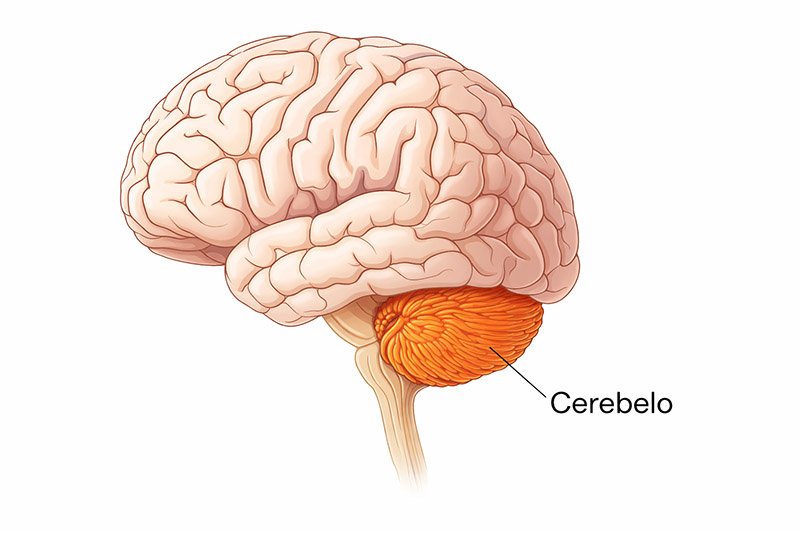
Functions
Now let's delve deeper.
Motor control and balance
Its best-known function is to control body movements.
“"The cerebellum is responsible for adjusting and coordinating movements, ensuring balance and precision."”
Without it, even simple actions, like picking up a glass, would become awkward.
Coordination and precision
In addition, the cerebellum adjusts the intensity, timing, and direction of movements.
In other words, it functions as a "stock editor." It corrects errors in real time.
Have you ever noticed how you can type without looking at the keyboard? That's your brain structure in action.
Motor learning and memory
Over time, the cerebellum learns patterns.
It automates skills such as:
- drive
- to go by bicycle
- to write
- practice sports
Therefore, the more you repeat an action, the more efficient it becomes.
The impact on behavior
This brain structure doesn't just act on the body, it also acts on the mind.
Research shows that the cerebellum is involved in cognitive processes such as attention, language, and planning.
In other words, it directly influences how you process information.
Furthermore, it helps to predict consequences.
“"The cerebellum contributes to decision-making by adjusting patterns based on past experiences."”
This means that your choices are not only rational, they are also shaped by automated patterns.
Cerebellum and emotions: what neuroscience reveals
At first glance, its connection to emotions may seem strange.
However, it has direct connections with the limbic system, responsible for emotions.
This causes him to influence:
- emotional regulation
- stress response
- reaction patterns
In other words, it helps to "program" how you react emotionally.
The role of the cerebellum in automatic patterns and self-sabotage.
Much of our behavior is automatic, and the cerebellum plays a central role in it.
He learns patterns and repeats them.
This includes:
- positive habits
- negative habits
- emotional responses
“"The cerebellum helps automate behaviors, which can reinforce both positive habits and self-sabotaging patterns."”
If you've ever noticed that you repeat certain behaviors even though you know you shouldn't... the cerebellum is probably involved.
Habits and neuroplasticity
But none of this is fixed. Thanks to neuroplasticity, The brain can adapt and change.
The cerebellum learns through repetition.
I.e:
- Repeating a behavior reinforces it.
- Changes behavior → he adapts
“"The cerebellum is highly adaptable and can be reprogrammed through repetition and conscious practice."”
This opens up a powerful possibility: you can reprogram your patterns.
Dysfunctions and their consequences
When the cerebellum malfunctions, the impacts are clear.
Thus, the following may occur:
- lack of coordination (ataxia)
- difficulty with balance
- speech problems
- cognitive slowness
But it doesn't stop there.
They may also appear as:
- learning difficulty
- emotional changes
- impulsivity
This reinforces how much he goes beyond the movement.
How to stimulate the cerebellum to improve focus and performance.
If the cerebellum learns through repetition, then we can train it.
Activities that help:
- coordinated physical exercises
- balance practices
- meditation mindfulness
- learning new skills
Furthermore, the mindfulness It improves communication between the brain and the body.
Practical exercise for stimulation
Now, let's get practical.
Try this:
Sit comfortably. Close your eyes and focus your attention on your breath. Then, slowly raise one arm and observe every detail of the movement: speed, tension, and direction. Do this with extreme awareness.
Then, repeat with the other arm.
This simple exercise improves the connection between awareness and movement.
In addition, it stimulates the cerebellum and reduces autopilot.
Conclusion
The cerebellum is much more than a structure linked to movement. Above all, it is a true "silent programmer" of your behavior. It learns, automates, and reinforces patterns, both positive and negative. The big breakthrough is understanding that you are not trapped by these patterns. With awareness, practice, and repetition, it is possible to reprogram your brain and create new responses.
And ultimately, that changes everything.
FAQ – Frequently asked questions about the cerebellum
1. What is the cerebellum in a few words?
It is a part of the brain responsible for motor coordination, balance, and also for influencing behavior and learning.
2. Does the cerebellum influence emotions?
Yes. It connects to the limbic system and helps regulate emotional responses and automatic patterns.
3. Is the cerebellum linked to habits?
Yes. It automates repetitive behaviors, which is fundamental in the formation of habits.
4. Is it possible to train the cerebellum?
Yes. Physical activities, motor coordination, and mindfulness practices help to stimulate it.
5. Can the cerebellum influence self-sabotage?
Yes. Because it automates patterns, it can reinforce negative behaviors if there is no awareness and intervention.
Image: Freepik

Marcel Castilho is a specialist in mindset and human behavior. In addition to being an advertising professional, he also holds a Master's degree in NLP (Neuro-Linguistic Programming) and postgraduate degrees in neuromarketing, neuroscience, mindfulness, and positive psychology. As the owner and founder of the communication agency VeroCom and the digital agency Vero Contents, he has been studying human behavior for over 30 years.